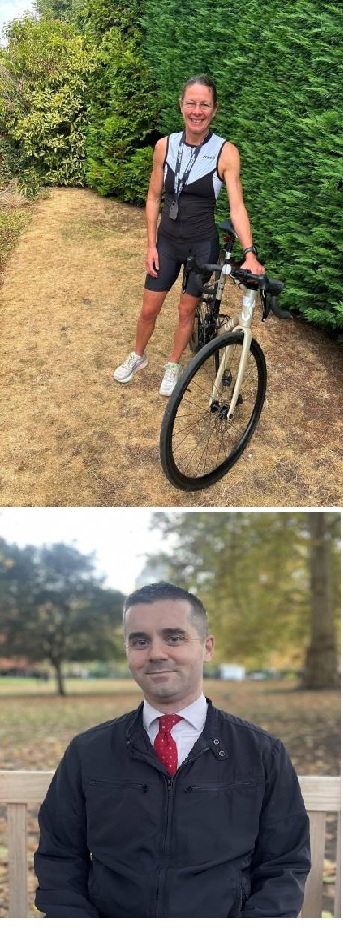
 Karen Cove, Trustee, says ‘on 20th September 2026, I will take on the challenge of completing the Ironman 70.3 Emilia Romagna’. – and we would love you to support her and us! https://gofund.me/11ec4af6e We have a great need for a sports field now that we have 300 children – with 15 and 16-year-olds studying in our additional classes 9 and 10 for their SEEs. (And they are much bigger than 3-year-olds!) All sport is played in strict 30-minute sessions, in the rather small playground, to allow girls and boys to play football on our quarter-size area. Karen says ‘I’m doing it both for the huge personal challenge and because I want to help create something lasting for the children of Hangdewa. My goal is to raise funds towards the purchase of land, near the school, that can become a dedicated sports field. A place where children can run, play, compete, build confidence, learn teamwork and have fun through sport and exercise, in a way that has always been important in my life and that I have taken for granted.’ This challenge has meant Karen has already competed in 3 triathlons as practice!
On Saturday 26th September, Owen Dobbing, an IT Prep School teacher in London, will be doing the Surrey Three Peaks challenge, a 23-mile circular route, climbing Box Hill, Holmbury Hill and Leigh Hill. Owen says ‘I have been providing advice on how technology can be taught at Q. Learning Nepal school (for example using Scratch for programming). I would love to help provide some equipment resources to generate opportunities for the children living and learning there.’ Just Giving
 On 15th November, Kesh Chauhan, together with those honouring his late brother, Flight Lieutenant Rakesh Chauhan, will be trekking to Base Camp Annapurna 4,130ms. Kesh says ‘We will be working alongside Q Learning Nepal to introduce 6-10-year-olds to computers. Beyond this, the older students will learn basic programming skills and will also enable 16–18-year-old students to borrow laptops for further education and establish a library system. This project will set the foundation for future generations of Nepali children to study computing and help become the future drivers of development in Nepal. The computers will be supplied by The Turing Trust which was founded by the family of the late Alan Turing. As a mathematician, Alan Turing was instrumental in cracking the Enigma code during World War 2 and is considered the father of modern computing.’
Help for Nepal – donations go direct to Victims of the Floods
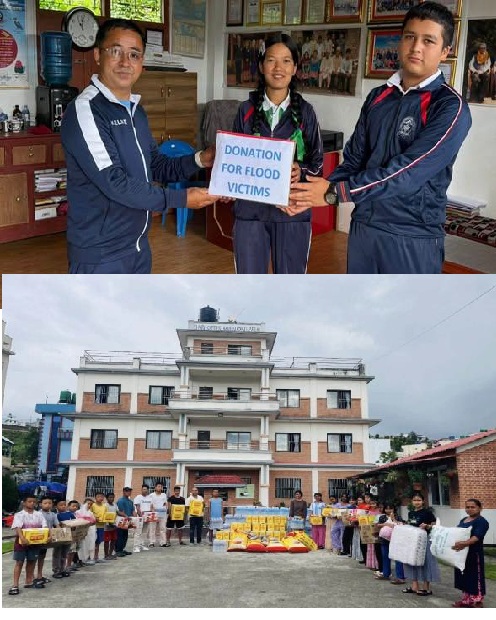
The tragedy of the recent Nepal floods in central Nepal was a huge shock to villagers in Hangdewa. Although we are about 340 miles away, teachers and children have close family members/friends who are missing. They have been through the gruelling wait, oscillating between hope and despair.
The question ‘how can we help’ has come up repeatedly from villagers and global supporters of Q. Learning Nepal. The children at our school decided they could give their Tiffin (lunch) money – and so collected money to donate to the emergency fund.
Meanwhile, Kate Jackson, one of our Trustees, also with oversight of the child centre ChoE in Kathmandu where 6 of our children live, has raised £2,145, with which staff at ChoE have bought, and children have bagged, essential foods and clothes, and then taken them to collection hubs to go to emergency shelters. They are also ready to give a home to up to 5 destitute children.
If you can, please support this work: Just Giving
Focus on our Major Donors – the Eifion Trust

Over the next few Newsletters, we will introduce you to our donors. First up is the Eifion Trust. After losing their beloved daughter Charlotte in 2013, Ann and Barry were determined to create a lasting memorial in her name. “Charlotte’s Haven on Earth” (ChoE) was built and 34 children live and learn there in safety and joy. Since 2023, many more young people have been given the chance to study with bursaries and scholarships on outreach programmes and, through their partnership with Q. Learning Nepal, our school in Hangdewa. Their work is continued by the family. Quite a legacy to take on – imagine that as an inheritance! Kate Jackson, Chair of the Eifion Trust, had never even been to Nepal but now visits every year at least once. We simply couldn’t do what we do without Kate’s, her family’s and the Eifion Trust’s support: it is not just the substantial financial commitment to our school: they are also there for our scholars, and our orphaned and disadvantaged children who now live at CHoE in Kathmandu.
From Toilets to Digital Learning – There is a lot happening at the School
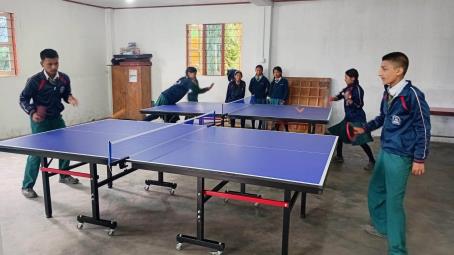
We really had to replace the toilets in the yellow/senior school. They were nearly 20 years old and the hole in the ground was full. Eifion gave us the money, Trump attacked Iran and suddenly the price of concrete and other building materials went up. That was when the Liebreich Foundation stepped in to make up the difference: this is from a family who had put aside money for the care of an elderly relative and now gives out money to good causes from what is left over. So we built the toilets and, having done our annual accounts, found we had enough money to build a room above them (the Nepalese Rupee is so weak that we had money we didn’t expect). We call this, rather grandly, ‘the sports hall’. Inside, is a concrete room with 2 table tennis tables, and a concrete floor where traditional dancing takes place. It is very well used.
There are times when all new things seem to be digital: the alumni and students making a vlog https://fb.watch/v/ffSIRrid-/ to showcase our school (it is amazing – do look!) and sending it off to Clapham Manor School in London as part of international studies (so interesting to compare our school with theirs); middle school students starting to learn Scratch for programming, using Owen Dobbing’s lessons from the UK; and teachers including our Advisor’s ‘Self Organised Learning Environments’ (SOLEs) as part of school life (children in groups of about 4 answer a question such as ‘why is cyber security so important?’ using laptops for research and then presenting their findings), https://en.wikipedia.org/wiki/Self_Organised_Learning_Environment#:~:text=Self%20Organised%20Learning%20Environment And in the yellow/senior school, the alumni and 2 boys from class 9 have revolutionised the library. In the pandemic, we had 50 books for the children to borrow and read at home. Now we have 1,600 and an old spreadsheet has outlived its appropriateness. So the team is using software to create a modern library system, paid for by Rak’s Trust, inputting books using mobile phones for QR codes.
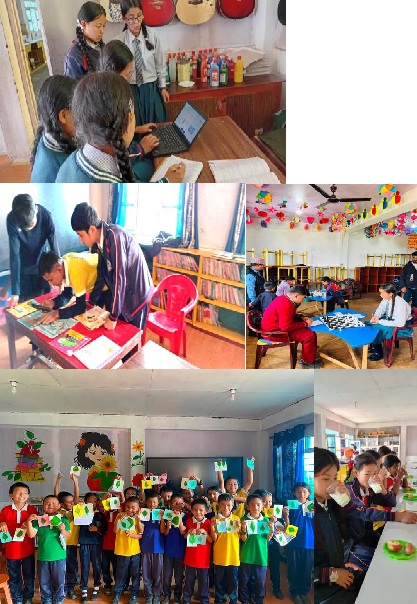
However, school life is far bigger than digital: Millfield School sells ice creams outside their library and the librarians send us the profits for our library….so we can buy more ‘read-it-yourself’ books in Nepali. And our wonderful alumni, home between courses, have spent the summer listening to our little students read because, down at the Montessori School, ‘A’ stopped being called ‘A’ and became ‘a’ as in cat. Phonics has hit the Himalayas and a movement accompanies every letter: hold up your hand to your face …and it becomes ‘m’ for ‘mirror’. There is a lot to learn for young children – and teachers too – but they chant them out pointing at letters with confidence. We hosted the inter-schools’ chess competition, with Kinjal representing our school (as the only girl present); 9-year-olds and younger have painted scenes form real life – leaves from outside in the jungle, and also rice to celebrate ‘paddy day’; Prize Day has celebrated academic achievements; snacks for those at risk of malnutrition have been reinvented as we get better at them; eye tests for children and teachers at the start of the school year….
The Village of Hangdewa puts its Arms Around our School

There has been a step-change in how the school has become central to village life and how that has benefitted our children. It all started when Millfield School visited last year and we put the organisation and hosting into the hands of our alumni: students who were 16-18 and had left the school, some back for the Dashain and Tihar holidays from far-away cities. They worked with current prefects and teachers in the mammoth task to move cooking, sports and other equipment from one school to another for daily activities, they welcomed our visitors in a vibrant program that ran to time, they helped to build the mushroom house, cook snacks for all participants (hundreds of children), ran the IT programs for food requirements and activities and made sure the evening entertainment was wow every time. The adults watched in awe.
Then they went off to their studies and created an alumni group with their own social media platforms to keep in touch and help each other. In the summer, they came back and have been involved in running projects all over the school. The vlog, library system, reading with small children, and safety online presentation were all achieved. Busy in the school, they also took time to remove litter, tidy up everyone’s favourite spot in the village, under the banyan tree, where they also planted flowers. They are an exceptional example to younger students.
And the parents and teachers have together formed a new School Management Committee (SMC). There were three parents’ meetings when volunteers became members. The plan is to increasingly devolve power from the UK charity. The school is overseen for financial and charitable purposes by more Nepali bodies, and the new SMC will start to take on more governance through policies and budgets. The processes are in place, and this is an important step forward in the village owning their education engine. And their topics of concern? Teenagers spending too much time on mobile phones (their parents’) and eating junk food (banned at school). Not all progress is good!
Global Arms around the children – our Mentors
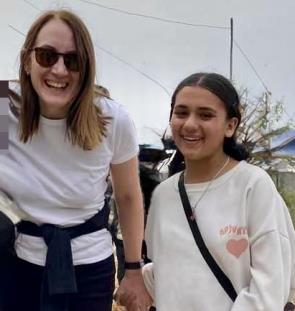
Roughly 15% of our income comes from sponsors who pay for our children to be at school. We ask for £25 a month. This includes fees, uniform, schoolbooks, occasional school trips and the use of the library, laptops, sports, science, art and general school resources/equipment and we meet other needs, for example food, glasses, sanitary wear and specialist disabilities equipment. In total, we need about £100,000 a year to run the school: about £333 per child. We believe we are unique as a charity in Nepal as we build the school, provide adequate resources, train the teachers, see the child as a whole person and believe they can all achieve their amazing potential – not just (but crucially important) academically but also in their talents. We believe that the school is a place we would be happy to see our children or grandchildren attending and that education is the cornerstone of improved life-chances. That is why ‘Mentors’ like you are so important. You are their special person in the outside world, you write them letters, remember their birthdays and are there when things go wrong – and right! Every child wants to be an ‘Ambassador’ and for you to be their ‘Mentor’. Please help if you can. Sponsor A Child | Q • Learning Nepal Trust CIO.