At our last Trustee meeting, we agreed that the shift this year has been the school becoming a place where we would be delighted to send our own children (or recommend for our grandchildren). For us, and I hope for you, it feels very good to be a part of something that doesn’t just hand out crumbs but hands out better life chances through education: our alumni, after all passing their SEE this year, continue to study for ‘Plus 2s’ (aged about 16-18) at their new schools in Kathmandu, Itahari and Dharan; they have a reputation for hard work and politeness, with many in the top 10% of their classes. This begs the question, ‘What next?’ Pauline and Laurie Bennett in New Zealand sponsor 2 students at university in Nepal: one near the end of a 4-year BSC course in Agricultural Science and the other is in year 2/4 of a BSC in IT and Computers.

It costs about £1,500 course fees and £1,500 living costs or £3,000 a year x 4 years. Student loans are unavailable/unaffordable for our students. With a science/maths/computer degree they can become nurses, doctors, radiotherapists, dentists, software engineers, project engineers, teachers and more. Very different from earning £3.00 a day working the land. They can also travel abroad to improve skills. The hope is that they will return to Nepal and help build it. If you can help them realise their dreams, please let us know contact@qlearningnepal.com. This year, it is likely that at least 2 of our 18 year-old students will achieve in the top 5% of results in Nepal for their ‘Plus2s’.
Education for the World’s Richest meets Poorest

Ours is a happy, friendly school where children flourish, additional needs are explored and supported, it has dedicated teachers and resources – including for STEM – as well as encouraging music, sport and art. In Nepal, this would be normal for only the richest children, the ones the violent, but brief, student protests were against – the children of politicians.
This October, we again hosted 21 students and their teachers from the UK’s largest public school, Millfield School – 2 to 18, boarding and day. The fees for two boarding students at Millfield School equate to what we spend on 300 students in Hangdewa. Their students were much taller but, otherwise, had so much in common with ours: we had joint project leadership, joint tasks, joint musical and sports challenges. Our teenage alumni ran the IT, the program/schedule and most of the entertainment and trips out, as well as including their guests in the religious festivals and rituals of Dashain and Tihar. Our teenage alumni and students also cleaned everywhere before and after, moved equipment up and down the mountain and sourced whatever was needed. It was a proud moment and one which our children were incredibly thankful for. They cannot fly around the world, but the outside world came to them. We are open to hosting other schools on an adventure trip to our school and can share ‘how tos’/contacts for travel and fundraising. contact@qlearningnepal.com

Projects included: creating a mushroom farm and vegetable garden for growing ingredients for free meals; cooking healthy snacks, running sports tournaments at the ‘youth club’ evenings, creating art, music and drama, managing ‘readathons’, trips to Hindu and Buddhist temples and our very long suspension bridge, visiting local houses and celebrating Tihar with sel roti, rangouli designs and dancing deusi bhailo.
Government Target: 75% of Students to achieve a ‘D’ grade – we are Outstanding: 100% passing well, averaging ‘B+’
We averaged B+ across all subjects and all students in the BLE – the public exam, which includes 8 compulsory subjects, in class 8 (at about aged 14), with no failures and some achieving in the top 1% of results nationally. Our young people are very thankful to be able to continue (from 2025) living at home to study for 2 years towards SEE public exams (at about 16): we have permission for two further classes. We have an outstanding reputation for miles around – and we are delighted that (finally!) we have 50% girls in the school. Poor and poorer all welcome, all faiths, castes and abilities. The normal rates of dyslexia etc apply! Is this a good measure of success?
What is Education? Are Government Expectations Right?
The student riots across Nepal, which lasted two days and resulted in over 70 students dead and the overthrow of the Government, were about corruption and unfairness, led by politicians and flaunted by their children (known as the ‘Nepo kids’ who showed off luxury brands on TikTok). Some of our children joined in smaller protests in the local town, Taplejung. They were furious at the killings and continue to feel deeply the lack of opportunities in Nepal. Land and businesses are owned by a few in the larger towns and nepotism is how jobs are gained. The interim Government, agreed with student leaders, has introduced new ideas – among them is an overhaul of education in Nepal. The changes are likely to be in line with how we run our school in remote Hangdewa: practical science and computers, the arts and sport.

But here’s the catch. We blasted the mountain to level enough ground for our ‘yellow’ school and a small playground – for 100 children aged 5-11. This building now has 150 children aged 9-16. These young people want to play sports, and we have just been placed 3rd amongst 15 schools for sport, winning 8 gold medals in martial arts, others for badminton and table tennis. But we have less playground space than a proper volley-ball court, or for more than one badminton court, insufficient space for a football game and even martial arts is challenged. Careful scheduling makes best use of the space, but the reality is we need a sportsground nearby. Some villagers have agreed to sell precious food-growing land at a discount. We need £20,000 for the land, flattening and fence. To help us contact@qlearningnepal.com or Donate | Q • Learning Nepal Trust CIO
In how many ways did we get computers to the Himalayas?
7 years ago, Home – Aptitude Software donated 20 computers from the UK. They created wonder!

They paid for a software engineer to travel from USA to help with them on arrival. She came, but the computers were held up in Kathmandu waiting for … well, let’s say money to release them. 6 months later, only 11 of the 20 arrived in Hangdewa, followed by two software engineers from the UK and Poland. They were wired up, software downloaded and the children started to use them. Manoj Tamang, our English (also music and economics) school leader, took on the job of teaching IT!
Every visitor brought laptops (cleaned and mended by Arthur Ashley) and some more were sent by Aptitude Software from Poland. Only these last ones were sufficiently good to last, even with support from Taplejung. Our Wi-Fi was weak and we discovered it came from India, via China and the Himalayas, hitched up over trees to our school. We contacted everyone we could think of to ask for 3G at least (including Nepal Telecom, the Gurkhas, BBC World Service, Starlink) and then, one day, a lorry arrived with internet fibre-optic cabling which we bought for £400 – suddenly we were reliably connected to the world. It meant that throughout the pandemic shutdown, older students were able to use a borrowed device to learn via zoom lessons.

Except the electricity was not reliable and would fail at every storm. Woken at 4.00 am, I was asked, “Would I fund an ‘Invotta’”. Drowsy, it took a while to approve an inverter. However, this became the villagers’ way of charging their mobile phones, and so the battery would barely last for more than shutting down the computers safely!

The game-changer this year has been Turing Trust – a Scottish-based charity collecting some of the 250,000 laptops deemed useless every year in the UK, refurbishing them and uploading useful software for schools. Experts in Malawi, we were an outlier in Nepal! During the first 6 months, every visitor (some unconnected with our work) took them out in hand-luggage. They weigh about 2 kilos. Nepal’s law allows importing only 1 at a time. In October, our visitors from Millfield School brought in 24. Instant game-changer. Meanwhile, EPAM | Software Engineering & Product Development Services earmarked some used laptops in Pune and Bangalore and sent them to the DHL office in Darjeeling, across the border from us. We took a jeep, filled with teachers and students, to India and opened the boxes. All the cables were there but only half of the laptops. A week later, the other laptops arrived. I was travelling south to north, staying in a hotel for a day at the border. The DHL officer took the box of laptops, drove across dirt tracks to me, by-passing the official border. Now, that’s what I call customer service!

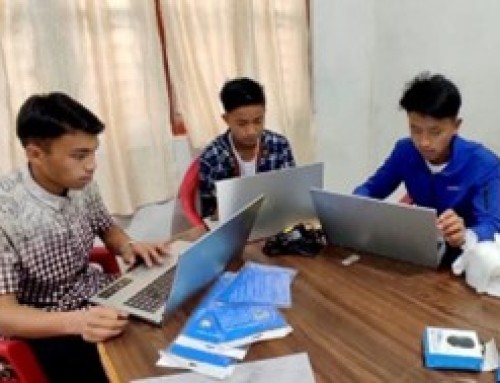
So now we have a computer room full of computers, and laptops for borrowing by the top classes and alumni for project work. Not just learning about computers but using them. We developed our own ‘healthy eating app’ which we started using in the Millfield School visit – enabling children to order free healthy snacks the day before (so we could cook them). We also developed a program schedule for the Millfield School visit for students to book onto activities going on throughout the day. E-commerce and project management has arrived in Hangdewa!
In October, we will be the beneficiaries of a trek to Annapurna Base Camp (4130 meters) sponsored by the Raks Trust.
If this is something you might be interested in, do contact me or Contact Us – The Flight Lieutenant Rakesh Chauhan Trust The money they have raised on other treks last year and this will fund a ‘library’ of laptops which students in and beyond the village will be able to borrow (with laptop bags!) to become proficient at home and school. It will also fund maintenance and (oh joy!) a teacher to provide qualified teaching in the curriculum, programming, AI etc. over several years. Imagine that: the technology deficit reduced.
Should we Feed Malnourished Children?
Most of our children are small in comparison to second generation Nepali in UK. They eat a limited diet of rice and lentils with some greens. – twice a day. Some have insufficient calories for their mountain living (walking several hours a day), many having a protein-poor diet and most have a lack of variety of vitamins etc. Following a whole-school at-risk register, we found the 30 children most at risk of mlnutrition.
We were given a start-up fund by comsim About Us – eCommerce and Digital Marketing. Children are at school 6 days a week for about 45 weeks a year – so the cost for one child’s nutritious daily meal is £320 per anum, which is more than we spend on the rest of their education (£267). If you could support a hungry child, please go to Donate | Q • Learning Nepal Trust CIO A monthly donation of £25 will make all the difference.

Three months later, I listened to our science teacher explaining life after the introduction of free, nutritious meals for the 30 lucky children: ‘The children used to come into science lessons unable to focus properly and complaining of stomach pains. Their parents gave them 20 rupees (about 10p) for a snack at Tiffin and they bought a small packet of crispy noodles. But they were much too spicy for their stomachs and had very little food value. I spent the lessons giving out indigestion tablets! Now they are settled, focussed and good students – and they also love their free nutritious meals. All the children would like them!’
Reporting Back on Fencing You Donated Towards

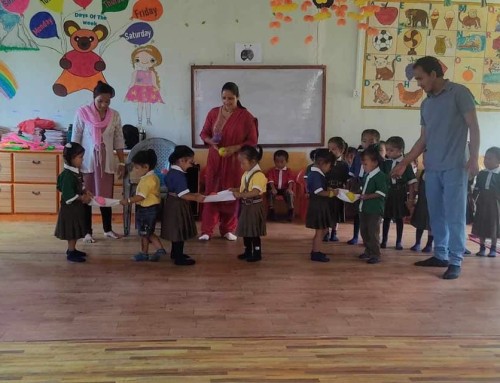
We asked for help with fencing round the Early Years Montessori School playing grounds. Many of you donated. Thank you. It has proved a typical Nepali project: not at all easy! The villagers took the opportunity to carve a way up the mountain from the lower yellow school, creating hundreds of concrete steps. Where they carved into the side of our land, it collapsed, causing land to be continuously eroded with each storm.
So we have built gabions along the length of the collapsed field and from low down to high up. We are getting on with fencing and will hope to send photos soon!

Wishing you a very Happy 2026!
Thank you for your continuing support. Small or big, it all makes a huge difference.
Amazing things happen when we help.